

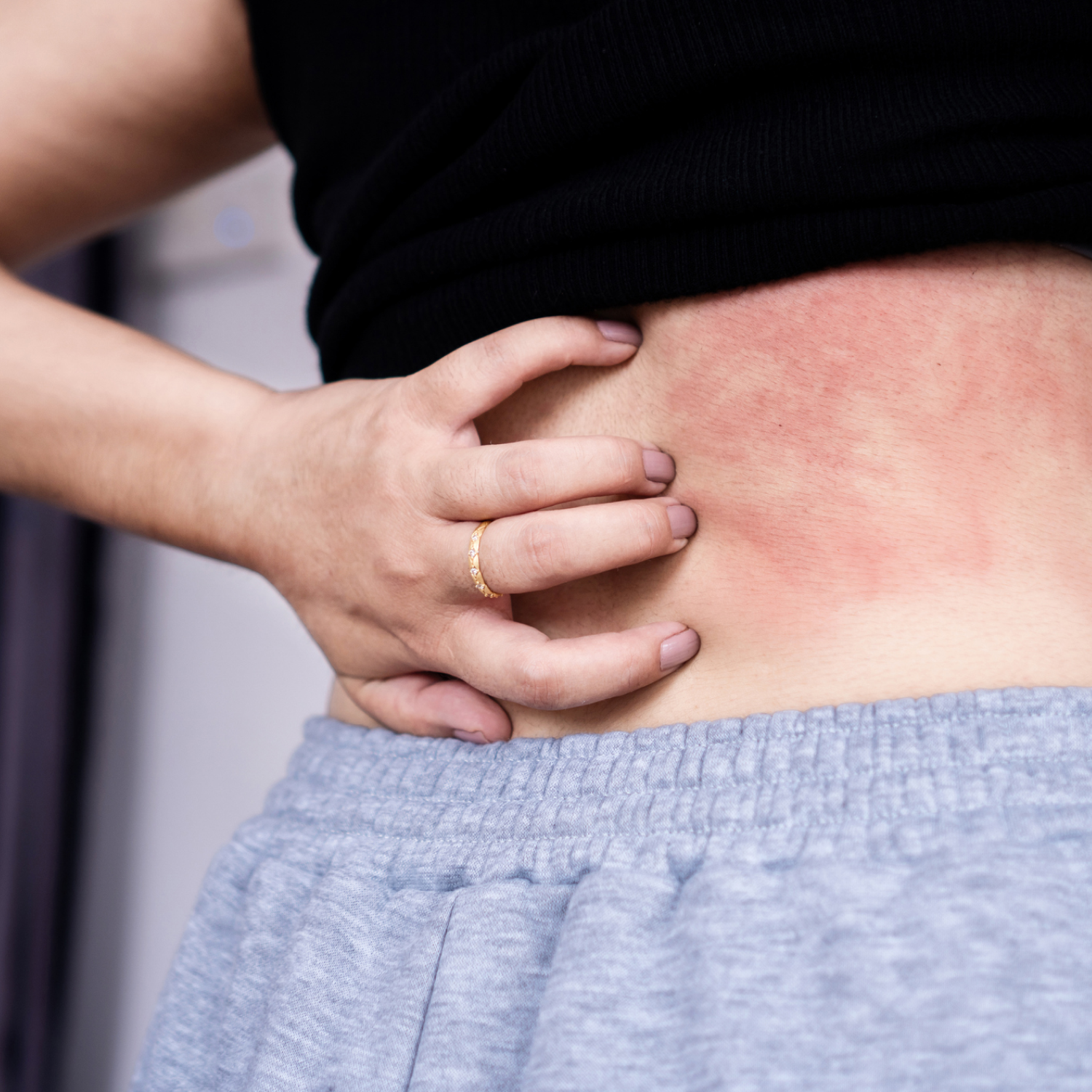
In this article, you’ll learn why stress affects the skin so directly, how neurodermatitis and stress fuel each other, what you can specifically do to break out of this vicious cycle — and how the salt shower can support you in the process.
You know those phases when everything hits at once: a demanding job, a difficult family situation, too little sleep, and the feeling that nothing ever calms down. And you know exactly what that means: The next neurodermatitis flare-up won’t be long in coming.
You may have already heard the sentence: “Just don’t stress so much.” It’s probably one of the least helpful things someone with neurodermatitis can hear. Because stress can’t simply be switched off. And neurodermatitis certainly can’t.
Many people with neurodermatitis know this pattern all too well, without realizing that there are very concrete biological reasons for it. Stress is one of the biggest triggers for the skin, but it’s also a trigger you can actively work on once you understand what’s actually happening in the body.
In this article, you’ll learn why stress affects the skin so directly, how neurodermatitis and stress reinforce each other, and above all, what specific steps you can take to break out of this vicious cycle.
What Happens in Your Skin During Stress?
Neurodermatitis — medically known as atopic dermatitis — is a chronic inflammatory skin condition. The core problem lies in the skin barrier: It doesn’t function as it should. The skin loses moisture more quickly, struggles to protect itself against external stimuli, and the immune system reacts excessively to substances that are actually harmless.
Stress affects this already sensitive skin through three mechanisms that reinforce one another.
 1. Cortisol Flips from Brake to Accelerator
Cortisol is mainly known as the stress hormone, but it has a second crucial role: In acute stress situations, it has anti-inflammatory properties.
With chronic stress, however, the system flips. Cortisol levels remain permanently elevated, the body gets used to it, and the protective effect diminishes. At the same time, persistently high cortisol weakens the skin barrier: The skin loses more moisture, becomes drier, and irritants can penetrate more easily. What is a natural brake in the short term becomes fuel for exactly the inflammatory reactions that can trigger a flare-up in the long term.
2. The Sympathetic Nervous System Dominates – The Parasympathetic Can’t Kick In
Your autonomic nervous system has two modes: the sympathetic nervous system (the accelerator — responsible for fight, flight, and activity) and the parasympathetic nervous system (the brake — responsible for rest, digestion, and regeneration). Both need each other. Ideally, they alternate throughout the day.
With chronic stress, however, the system stays stuck in sympathetic mode. The body never receives the signal: “You may recover.” Yet it is exactly this signal that the skin needs to regenerate — to rebuild the skin barrier and calm inflammatory processes. When the parasympathetic nervous system doesn’t get a chance to activate, the skin lacks the inner recovery phase it desperately needs.
3. The Nervous System Transmits Tension Directly to the Skin
The skin and nervous system are biologically more closely connected than most people realize. The skin contains mast cells that can release inflammatory messengers such as histamine within seconds. These are activated, among other things, by messenger substances that come directly from the nerve endings in the skin.
This means: Stress doesn’t have to “travel” through the entire body to reach the skin. It arrives within minutes. This is exactly why many sufferers can almost feel a flare-up before it becomes visible — a tingling, a first burning sensation, or itching that seems to come out of nowhere.
The Vicious Cycle: How Stress and Neurodermatitis Reinforce Each Other
When stress triggers a flare-up, the story doesn’t end there. On the contrary — this is where it really begins.
You go through a stressful period and your skin reacts. Suddenly, additional burdens appear: You sleep worse because it itches at night. You feel uncomfortable in your own skin. You may avoid social meetings because you feel ashamed of your skin. You may get angry with yourself because you “can’t get it under control.” All of this creates new stress. And new stress means more cortisol, more sympathetic activation, and more itching in the skin. The flare-up intensifies — and so does the stress that triggered it.
This is the vicious cycle of stress and neurodermatitis. And it’s a stubborn one.
The good news: You don’t have to eliminate stress from your life completely to break this cycle. Because honestly — that’s simply not possible.
What you can do, however, is consciously create counter-impulses with small changes in your daily life.
Reducing Stress with Neurodermatitis: 8 Measures That Can Really Help You
Quick note beforehand: What works best for you depends on your daily life, your nervous system, and your personal situation. Try things out and be kind to yourself if not everything works right away.
1. Self-Created Stress or External Stress?
A lot of what feels like external pressure is actually self-created: your own expectations, the feeling that you have to prove something to someone, old issues that no longer serve you. Taking an honest look at this can be uncomfortable, but it is often the most powerful first step.
Ask yourself calmly: Which expectations am I currently fulfilling that aren’t actually mine? Where am I trying to prove something I don’t need to prove? Which issue am I still carrying around that is allowed to go? Sometimes just saying it out loud or writing it down is enough to realize that a large part of the burden isn’t coming from outside, but from self-imposed standards that no longer serve you.
2. Activating the Vagus Nerve: Small Exercises with Big Impact
The vagus nerve is the main nerve of your parasympathetic nervous system — exactly the “rest brake” that’s missing during stress. It can be actively activated, often within seconds.
Exercises that have been proven to work:
- Long exhales – breathe out longer than you breathe in (e.g. 4 seconds in, 6–8 seconds out)
- Humming or softly singing – the vibration in the throat directly stimulates the vagus nerve
- Let cold water run over your face
- Do the physiological sigh – one deep breath, followed by a second short breath, then a long exhale

3. The Salt Shower as Targeted Support for Your Skin
Many people with neurodermatitis know the phenomenon: After a beach holiday, the skin feels noticeably calmer. This is due to the composition of seawater. Minerals such as magnesium, potassium, and calcium can support the skin’s natural protective function and help strengthen the skin barrier. Salt also has a gentle cleansing effect and can help reduce bacteria on the skin’s surface that often worsen inflammation in neurodermatitis. The result: The skin feels calmer.
With the shower+ salt shower, you can easily incorporate this effect into your daily routine — and at the same time do something that is especially important during stressful periods: consciously take time for yourself. Three minutes in which you don’t have to do anything except let warm water and sea salt flow over your skin. Three minutes in which your nervous system can calm down while your skin is cared for.
4. Get Outside into the Fresh Air
Yes, this tip is often mentioned. And even if you tend to roll your eyes — it is one of the best-supported tips there is. Daylight regulates your internal clock and thus your cortisol rhythm. Exercise actively breaks down stress hormones. Fresh air and natural stimuli can activate the parasympathetic nervous system.
5. The 5-4-3-2-1 Method
When your mind is already racing to the next to-do, the next conflict, or the next “what if”, grounding brings you back to the present. The simplest exercise comes from trauma and stress therapy: 5-4-3-2-1.
Look around and name in your mind: 5 things you can see. 4 things you can hear. 3 things you can feel. 2 things you can smell. 1 thing you can taste. It may sound small, but it is neurologically highly effective: You interrupt the stress loop in your head because your brain cannot ruminate and process sensory impressions at the same time.
6. Counter-Stimuli: How to Interrupt Both Stress and Itching at the Same Time
When your mind won’t stop racing or your skin starts itching, a conscious counter-stimulus can interrupt both at the same time. Your brain shifts its attention to the new, stronger signal — and suddenly the stress or itch signal moves into the background.
Concrete options that many sufferers find surprisingly effective:
- Let cold water run over your hands and forearms
- Stand or lie on an acupressure mat for a short time
- Knead a metal spiky ball in your hand
- Place a cooling pack on an itchy area
The goal: Get out of your head and into sensing — and at the same time create a counter-stimulus for the skin that intercepts the urge to scratch without causing further damage.
7. Coffee and Sugar – Even If You “Don’t Feel It”
Coffee during stressful periods is like pressing the accelerator with the handbrake on. Even if you barely notice the caffeine anymore — your body still reacts to it. Caffeine further increases cortisol release, especially when the stress system is already running high. Sugar causes blood sugar fluctuations that can themselves trigger a stress response. You don’t have to eliminate either completely. But during particularly stressful phases, consciously reducing your intake can noticeably relieve the burden — more than most people expect.
8. Take a Break and Honestly Ask: What Do I Need Right Now?
Perhaps the most inconspicuous tip and at the same time the most powerful. When stress is building up inside you: consciously step away from the situation for a moment. Stand up. Breathe. And honestly ask yourself: What do I really need right now?
A warm cup of tea. Ten minutes of fresh air. Two minutes in a dark, quiet room. A short call with someone who makes you feel good. Or simply giving yourself permission not to have to function.
This question is the exact opposite of “Just don’t stress so much.” It takes you seriously. And that’s exactly what you need most in that moment — more than any well-meaning advice from outside.
This article is for general information purposes only and does not replace medical diagnosis, advice, or treatment.
If the itching is persistently so severe that you sleep poorly for weeks, if skin areas are weeping or inflamed, if scratched areas worsen despite care, or if no everyday measures help anymore, a visit to a dermatologist is the right next step.
If the psychological strain remains consistently high and you feel you can’t get out of the stress cycle on your own, psychological or psychotherapeutic support is also a very sensible option.
Conclusion: Small Steps That Break the Vicious Cycle
Stress and neurodermatitis reinforce each other. But precisely because this cycle has roots, it also has concrete starting points. You don’t have to change everything at once. Even a single new routine can make a big difference.
The most important measures at a glance:
- First, sort it out: Which stress is self-created and which comes from outside?
- Activate the vagus nerve: long exhales, humming, cold water on the face
- Use the salt shower as targeted support for your skin
- Daylight and fresh air – ideally in the morning
- Use 5-4-3-2-1 to return to your body
- Set counter-stimuli to interrupt stress and itching
- Consciously reduce coffee and sugar
- Take a break and honestly ask: What do I need right now?
You don’t have to eliminate stress from your life — that’s not even possible. What you can do is learn to meet it differently and give your body the breaks it needs.
→ Would you like to learn more about the salt shower?




Leave a comment
This site is protected by hCaptcha and the hCaptcha Privacy Policy and Terms of Service apply.